Dairy operations in the Fraser Valley run on tight margins and tighter timelines. When milking ends, the clock starts: raw milk must be cooled, held, and shipped within strict temperature bands — every milking, every day.
The right dairy farm refrigeration setup, backed by vigilant maintenance and 24/7 support, is the difference between consistent quality and costly rejections.
As a local HVAC-R partner serving Chilliwack as our base, with active work across Abbotsford and Langley, Alpine Refrigeration understands both the regulations and the realities on the ground — from summer heat spikes to overnight pickups and the need for rapid service when a tank alarm sounds.
Why Fast, Compliant Cooling Matters
Milk quality is time‑ and temperature‑sensitive. British Columbia's Milk Industry Standards Regulation sets explicit limits for farm holding tanks. In most parlour setups, when milk enters an empty tank, it must be cooled to ≤ 10°C within one hour of commencing milking, then to > 0°C and < 4°C within two hours of completing milking. When adding to non‑empty tanks, the combined milk must be ≤ 10°C at the time of blending, then > 0°C and < 4°C within one hour of completing milking. After cooling, milk must be held between 0 and 4°C until pickup. These time–temperature windows are enforceable and current as of 2024.
Beyond the bulk tank, programmatic compliance also matters. On Canadian dairy farms, proAction is mandatory nationwide and identifies "cooling & storage of milk" as a critical control point validated annually. That puts reliable refrigeration and documentation at the centre of quality assurance audits as well as daily operations.
Precise cooling, stable holding temperatures, and proof (logs) are non‑negotiable in BC. Designing your system to meet those thresholds on the hottest day and keeping it maintained so it does so repeatedly protects both quality and revenue.
From Parlour to Tank: How a Modern Milk Cooling Line Works
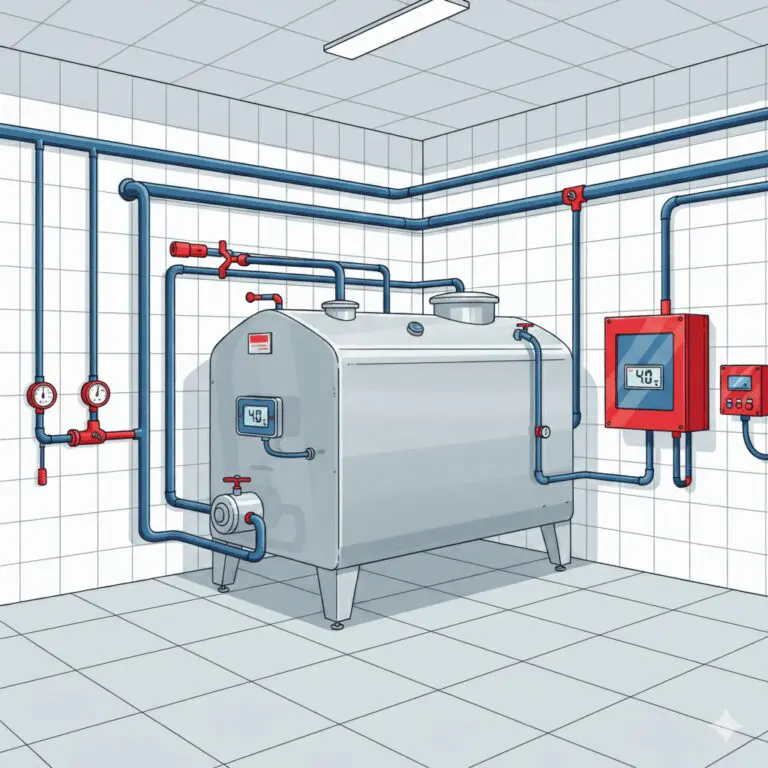
A typical Fraser Valley installation pairs plate precooling with a refrigerated bulk milk cooler ("bulk milk cooler" or milk tank cooling system). The process usually looks like this:
- Precooling at the plate heat exchanger (PHE): Effective plate cooling reduces milk temperature to a level close to the incoming water or glycol loop temperature before it reaches the tank, thereby easing the refrigeration load and improving compliance during warm periods.
- Final pull-down and holding in the tank: The tank's refrigeration circuit (direct expansion or glycol‑jacketed) finishes the pull‑down and maintains setpoint with controlled agitation for uniformity.
- Documentation and alarms: proAction expects verifiable cooling and storage practices. Many farms now use integrated data logging with alarms for overtemperature, power outages, or compressor faults — a practical safeguard when the barn is quiet at 2 a.m.
Well‑sized plate precooling combined with a properly matched tank reduces compressor run time, improves the chances of hitting "≤ 10°C inside one hour," and keeps the tank within > 0–< 4°C with less stress on mechanical components. In short, you are not only protecting milk — you are protecting the refrigeration plant that protects your milk.
What the BC Standard Means for System Sizing
Regulation isn't just about the thermometer. BC requires each farm holding tank to have sufficient capacity to hold all milk between pickups, and it stipulates that every point where milk enters or leaves is protected from contamination and housed within the milk house. It must also be capable of cooling to the required thresholds — a performance standard, not just a static specification.
Practical implications for tank and compressor selection:
- Tank capacity and pickup schedule: Undersized tanks run longer, hotter, and closer to their limits, especially in summer or during high‑yield periods. Design for your busiest day — not your average one — and plan for headroom to accommodate future herd growth.
- Compressor horsepower and staging: Staging (or a variable‑speed drive) helps the system respond to heavy draw during milking without short‑cycling afterward. This smooths the pull‑down curve and reduces nuisance trips or out‑of‑range alarms.
- Pre-cooling first: Every degree removed before the tank reduces refrigeration load. During water-scarce periods, a glycol chiller, used as the second stage of plate cooling, provides consistent approach temperatures.
- Agitation and measurement: Meeting the 5-minute-per-hour agitation requirement and using an accurate probe are compliance issues and good practices for uniformity and reliable sampling.
Barn Ventilation and Milk Cooling Go Hand in Hand
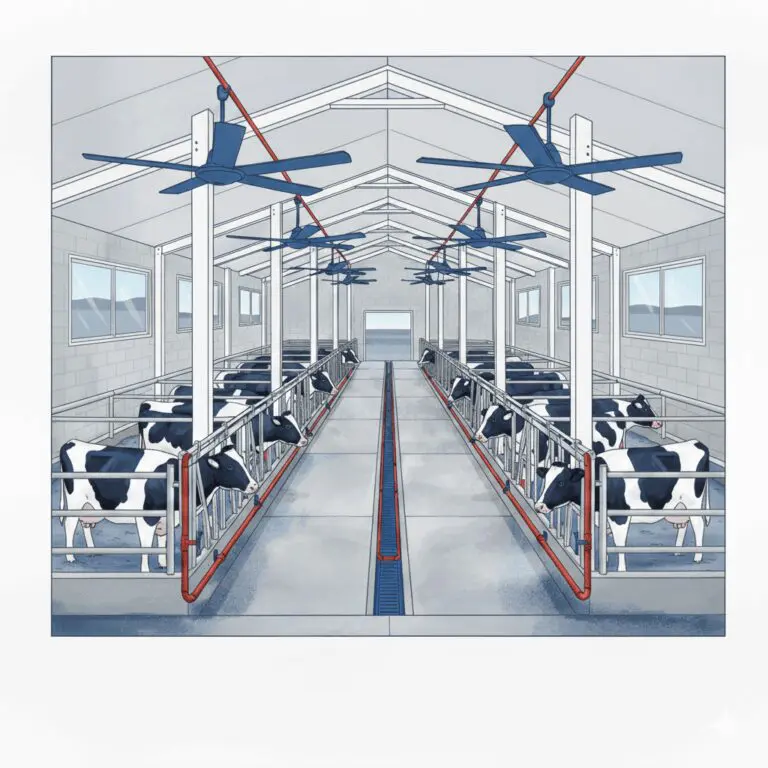
High ambient temperatures, stagnant air, and radiant heat increase heat load on both animals and equipment. In summer, dairy barn ventilation strategies — cross‑ventilation, high‑volume low‑speed fans, and targeted air exchange — reduce heat stress on cows and improve milking behaviour, while also lowering the temperature of incoming milk and the environment around your tank and plate cooler.
In Alpine's agricultural work across the Fraser Valley, we observe improved cooling stability when ventilation is addressed in conjunction with refrigeration, especially in older parlours that lack modern airflow design or have cluttered mechanical rooms that restrict condenser airflow.
Energy Efficiency Opportunities That Pay Back
Cooling milk is energy-intensive, but modern systems offer several ways to lower operating costs without compromising compliance.
Heat recovery for water heating is one of the most effective strategies for conserving energy. Compressor waste heat can preheat wash water for cleaning and hygiene, offsetting the need for electric or gas usage, and it remains a straightforward add-on that provides year-round value.
Intelligent defrost and condenser maintenance also play a major role. Clean coils and properly functioning fans improve heat rejection and reduce compressor run time. A monthly condenser rinse during dusty seasons can noticeably impact the hydro bill.
Data-driven setpoints complete the picture. By reviewing logged data, farmers can confirm whether the system consistently reaches 10°C within the first hour and 4°C within the required window. If performance is close to the edge, the data often points directly to the cause, whether it be plate cooler flow rates, water temperature, compressor capacity, or agitation timing. In this way, compliance data doubles as a diagnostic tool that prevents failures before they occur.
Preventive Maintenance That Prevents Rejections
A farm's maintenance rhythm is a competitive advantage. Based on local dairy service experience and BC's regulated requirements, a practical maintenance cadence looks like this:
- Daily: Visual check of tank temperature, listen for unusual compressor or fan noise, and conduct a quick inspection for leaks. Record temperatures at the end of milking and before pickup (supports proAction).
- Weekly: Verify agitation function, inspect gaskets and tank ports, and ensure the thermometer reading aligns with a reference thermometer.
- Monthly/Seasonal: Deep‑clean condenser coils; verify plate cooler flow and backflush to remove mineral scale; inspect glycol concentration and pump operation; review data logs for trends (longer pull‑downs suggest a developing issue). Schedule this ahead of peak summer heat to build resilience.
- Annually: Full system inspection and performance test; confirm defrost strategy; validate alarm setpoints and notification trees; assess pickup timing and volumes vs. tank capacity; refresh your emergency response plan.
What to Do When Something Goes Wrong
Even the best‑run barns see the occasional failure: a lightning‑related outage, a seized condenser fan at midnight, or a glycol pump fault during a heat wave. Here's where having a 24/7 emergency response partner — and a clear plan — is critical. Alpine Refrigeration positions emergency response as a core service for agricultural clients in Abbotsford, Mission, Langley, and the broader Fraser Valley, including phone triage, on‑site diagnostics, and interim solutions to protect milk until permanent repairs are made.
A practical emergency checklist:
- Contain: Keep the tank closed, maintain agitation if possible, and reduce heat load around condensers (open mechanical room doors, clear obstructions).
- Verify: Confirm actual milk temperature with a calibrated handheld thermometer and check the breaker panel for obvious electrical faults.
- Call: Reach your service provider with the readings, last log time, and any alarm codes; this speeds dispatch with the right parts.
- Document: Note times, temperatures, and actions taken — this supports both proAction verification and discussions with graders.
Planning an Upgrade
When planning a milk tank cooling system upgrade or new build, decisions should align with both regulatory targets and future growth. Start by reviewing recent temperature logs to see if your system consistently reaches 10°C within the first hour and 4°C within the required time. If not, the gap highlights where improvements are needed.
Size equipment for peak summer conditions, considering yield, pickup schedules, and afternoon milking. A two-stage plate cooler with glycol provides reliable precooling, while a properly sized tank ensures sufficient capacity for herd growth and route delays.
Utility spaces should have proper airflow, drainage, and access for maintenance. Finally, integrate monitoring and alarms with backup power so performance issues are visible before they become costly. Alpine's experience with dairy, poultry, and greenhouse operations across the Fraser Valley ensures systems are both compliant and practical.
Local Support, Built for Agricultural Operations
Alpine Refrigeration's core markets include residential, commercial, and agricultural refrigeration, with a long-standing local presence and fast response — critical in time‑sensitive, perishable environments like dairy. Our internal analysis emphasizes defending and growing our share in Chilliwack, as well as expansion across Abbotsford and Langley. That means our technicians, parts inventory, and on‑call system are geared to barns and plants — not just houses and stores.
From bulk milk coolers and plate heat exchangers to ventilation and emergency service, we build systems and maintenance plans around your rhythms: milking times, wash cycles, and pickup windows.
Planning Support or Urgent Help?
If you want a quick system review or need same‑day service on a tank, compressor, or plate cooler in Chilliwack, Abbotsford, Langley, or Mission, we're ready to help. Our team understands the standards, the stakes, and the schedules that keep Fraser Valley dairy moving.
FAQs
Need Professional Help?
Alpine Refrigeration has been serving the Fraser Valley since 1969. Our licensed technicians are available for consultations, installations, and 24/7 emergency service.