Dairy Refrigeration Beyond the Bulk Tank: Plate Coolers, Ice Banks, and Glycol Systems Compared
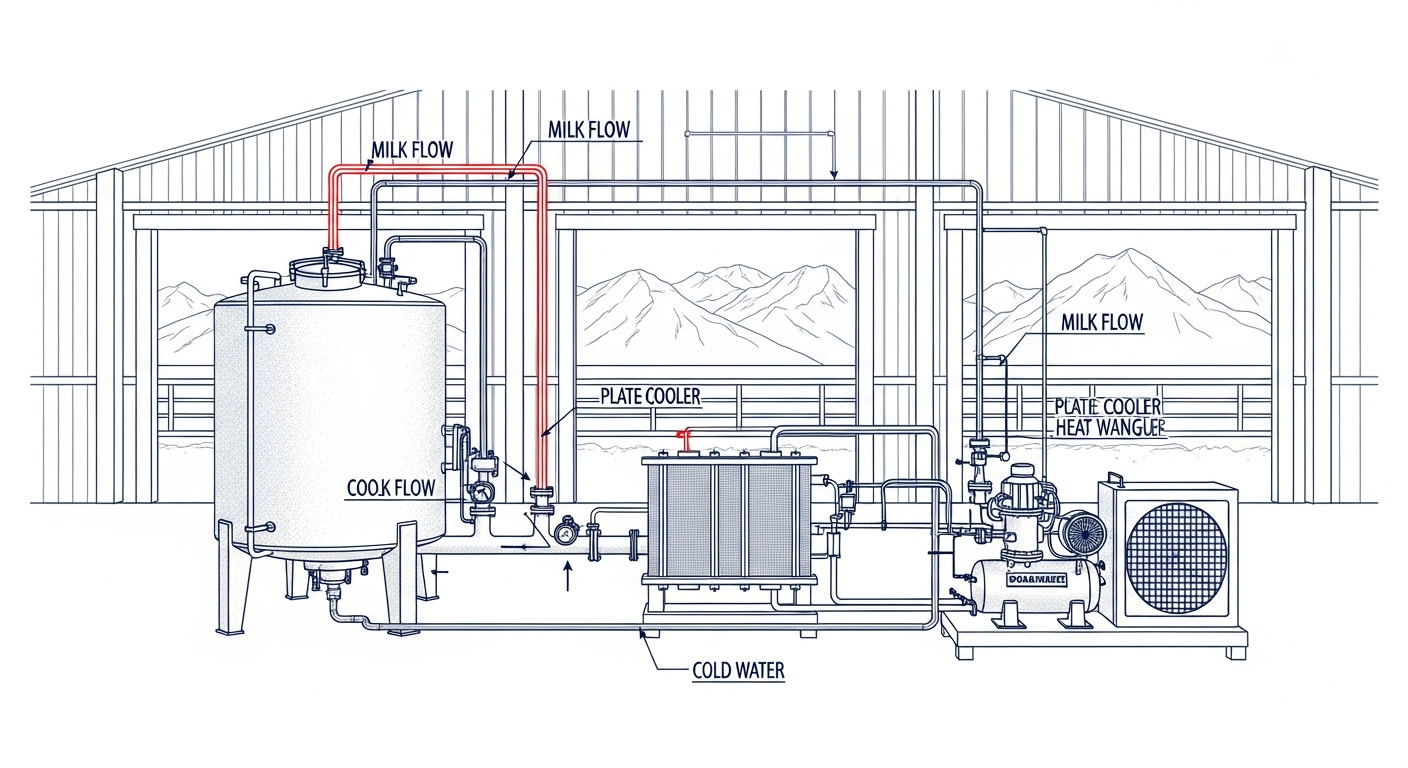
Milk leaves the cow at about 38 degrees Celsius. From that moment, the clock is running. BC dairy standards require milk to be cooled fast and held cold, and every minute it spends warm gives bacteria room to multiply.
Most Fraser Valley dairies rely on a direct expansion bulk tank to do that work. It is proven equipment, but on its own it is rarely the whole answer. There are three main milk cooling systems that work with or beyond the tank: plate coolers that strip heat before milk ever reaches it, ice banks that build chilling capacity overnight, and glycol systems that cool continuously. The right fit depends on your herd size, your milking schedule, your water and power supply, and whether you are running a parlour or robots.
Why Milk Cooling Is a Bigger Decision Than the Tank Itself
BC’s Milk Industry Standards Regulation sets the targets. Milk going into an empty tank must be at 10 degrees or less within one hour of starting to milk, then held between 0 and 4 degrees within two hours of finishing. Add a second milking to a tank that already holds milk and the rules tighten: the blend cannot exceed 10 degrees when the milkings combine, and the combined milk must be back under 4 degrees within an hour.
That blend rule is where undersized cooling gets exposed. Warm milk hitting a full tank pushes the whole batch up, and if your system cannot pull it back down fast enough, you are offside even though the tank itself is working fine.
The stakes show up in two places. First, milk quality: slow cooling raises bacteria counts, and repeated violations cost you money and standing with your processor. Second, your hydro bill: milk cooling is consistently one of the largest electrical loads on a dairy farm, which means the architecture you choose shapes your operating costs for the next 15 to 20 years. The question is not just “what size tank do I need.” It is “how do I remove heat from milk quickly, reliably, and at the lowest cost per litre.”
Plate Coolers Strip the Heat Before It Reaches the Tank
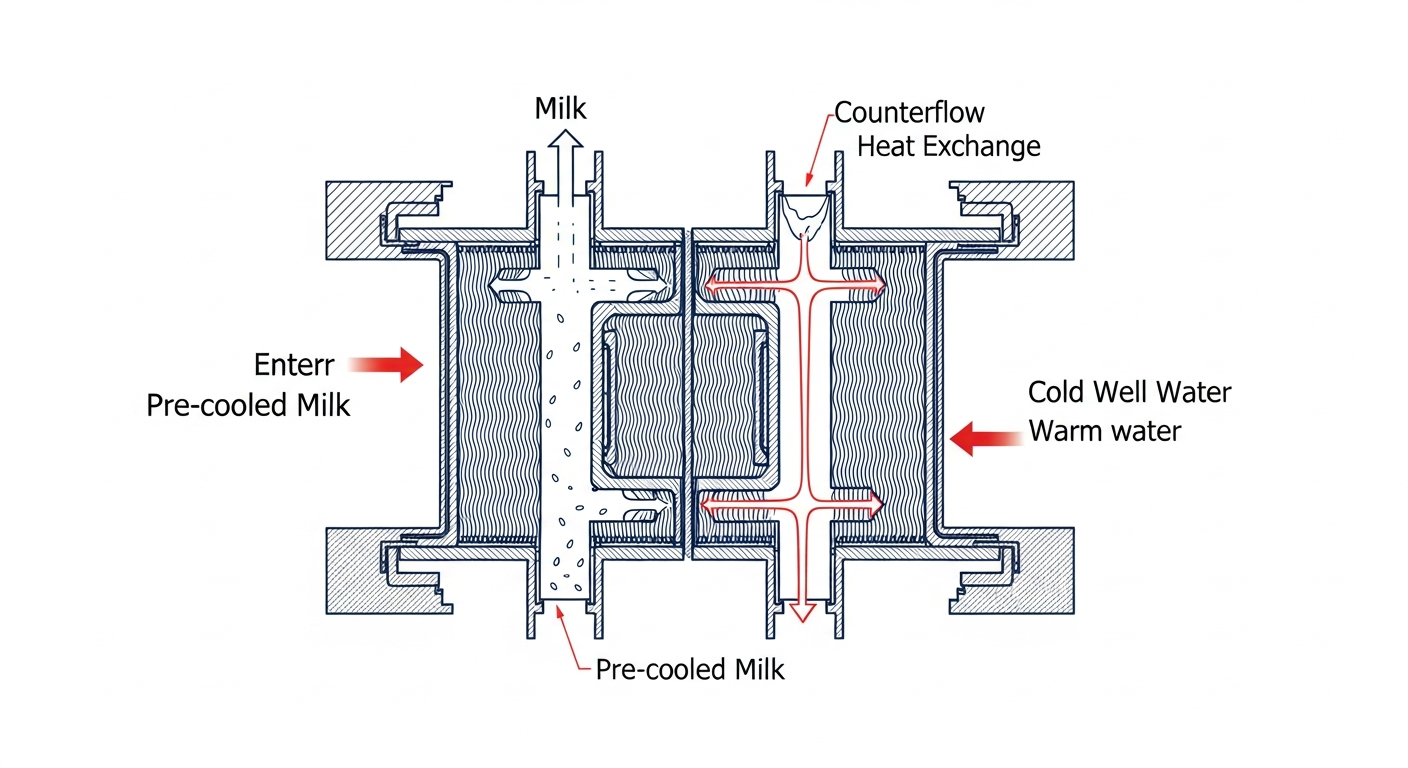
A plate cooler, sometimes called a precooler, is a stainless heat exchanger mounted between the receiver and the bulk tank. Milk flows through one side, cool well water flows through the other in the opposite direction, and heat moves from milk to water.
With adequate water flow, a plate cooler can drop incoming milk to within a few degrees of your groundwater temperature before the tank’s compressor does anything. University of Wisconsin extension research puts the ceiling high: a properly sized precooler can cut milk cooling costs by up to 60 percent where well water runs around 13 degrees. In the Fraser Valley, where groundwater runs cool most of the year, conditions favour this technology.
Quick Fact
The two most common reasons precoolers underperform are undersized water lines and an inadequate water supply, not the plate pack itself. A plate cooler needs roughly two litres of water per litre of milk to perform well. There is also a second win: the water leaving the plate cooler comes out warmed, and cows drink more of it than cold water. Routing it to a trough turns a waste stream into intake.
The limits are practical. A plate cooler precools rather than replaces your tank refrigeration. For most parlour operations, it is the first upgrade to consider, not the last, and it pairs with every other system on this list.
Ice Banks Build Tonight’s Cooling for Tomorrow’s Milking
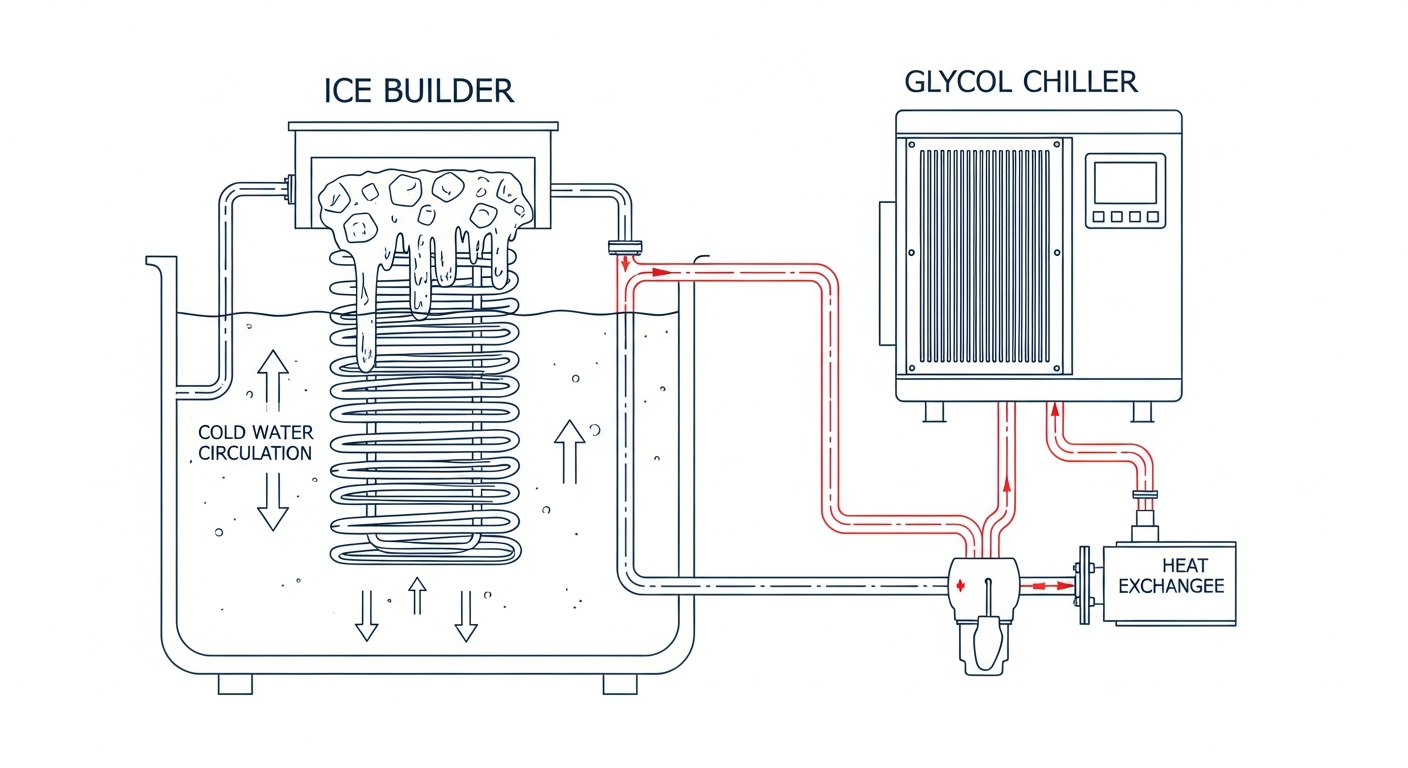
An ice bank, also called an ice builder, takes a different approach: instead of cooling milk on demand, it stores cooling capacity in advance. A refrigeration unit freezes a thick layer of ice on coils in an insulated water tank during the hours between milkings, often overnight. When milking starts, ice-chilled water circulates through a heat exchanger and pulls heat out of the milk almost instantly.
The appeal is peak capacity. If you milk a large herd through a fast parlour in a short window, the instantaneous cooling demand is enormous. An ice bank lets a modest compressor build that capacity slowly, then release it all at once. That can matter on farms where the electrical service cannot support a large direct expansion compressor, and it can shift electrical load into off-peak hours.
The honest tradeoff: freezing water and then melting it is less energy-efficient overall than cooling milk directly, and ice banks lose some capacity to standby melt. They earn their keep where peak cooling demand or limited power supply is the constraint, not where overall efficiency is the goal.
Glycol Systems Cool Continuously and Precisely
A glycol system uses a chiller to cool a food-safe glycol and water mix, which then circulates through heat exchangers to cool milk. Because the chilled loop runs whenever it is needed, glycol cooling handles milk that arrives continuously rather than in batches.
That is exactly why glycol has become the standard partner for robotic milking. Robots deliver milk in a slow, steady trickle around the clock. Send that trickle into a direct expansion tank and the evaporator can freeze the thin layer of milk on the tank floor, damaging quality. BC’s own regulation acknowledges the difference: milk from automated milking systems gets its own cooling provisions, separate from the parlour rules. A glycol loop cools gently and continuously, matching how robotic systems actually produce milk.
Glycol systems also scale well. Adding capacity usually means adding chiller capacity rather than replacing tanks, which suits farms with expansion plans. The tradeoffs are a higher upfront cost and more components to install and maintain than a straightforward tank-plus-plate-cooler setup.
How to Choose for Your Operation
There is no universal winner. There is a right fit for how your farm milks today and how it will milk in ten years.
- Parlour milking, stable herd size: a direct expansion bulk tank with a plate cooler ahead of it is the workhorse combination on most Fraser Valley dairies, and for good reason. It is simple, proven, and efficient.
- Large herd, short milking windows, or limited electrical service: an ice bank flattens your peak demand and delivers rapid cooling when the parlour is running flat out.
- Robotic milking, milk silos, or serious expansion plans: glycol cooling handles continuous low-flow milk arrival and scales with the operation.
- Any of the above: a plate cooler pairs with every architecture and is usually the cheapest heat removal you can buy.
Before committing to any system, get clear answers on four things: your well capacity and water flow rate, your electrical service capacity, your milking schedule and peak milk flow, and your herd plans over the life of the equipment. A cooling system sized only for today’s herd is often the most expensive mistake on the list, because it gets replaced twice.
Whatever You Run, Maintenance Decides Milk Quality
Every one of these systems depends on the same unglamorous fundamentals: clean condenser coils, correct refrigerant charge, accurate temperature sensors, and agitators that actually agitate. A neglected plate cooler fouls. An undercharged tank cools slowly and quietly pushes your blend temperature up.
One quick check any producer can do: look at the sight glass on the refrigeration line while the system runs. Clear liquid is healthy. Bubbles mean the charge is low, and it is time to call in a dairy refrigeration technician before the next milking.
For a full breakdown of what to look for and when, see our post on preventive maintenance for agricultural refrigeration. The farms with the best milk quality scores are almost always the ones with a scheduled maintenance program, not a reactive one.
Alpine Refrigeration has serviced dairy refrigeration in the Fraser Valley since 1969. We install and maintain plate coolers, ice banks, glycol systems, and bulk tanks across Chilliwack, Abbotsford, Langley, and the surrounding valley, and we run 24/7 emergency response because milk does not wait for business hours.
Frequently Asked Questions
How quickly does milk need to be cooled in BC?
Under BC’s Milk Industry Standards Regulation, milk in an empty tank must reach 10 degrees or less within an hour of starting to milk, then hold between 0 and 4 degrees within two hours of finishing. Combined milkings must blend at 10 degrees or less and return under 4 degrees within an hour.
Can a plate cooler replace my bulk tank refrigeration?
No. A plate cooler precools milk using well water, typically getting it within a few degrees of groundwater temperature. Your tank or chilled loop still does the final pull-down to 4 degrees and holds the milk cold. The plate cooler’s job is to shrink that final workload.
Why do robotic dairies need glycol cooling?
Robots deliver milk in a slow, continuous trickle instead of large batches. In a direct expansion tank, that thin flow can freeze on the evaporator surface and damage milk quality. A glycol loop cools gently and continuously, which matches how robotic systems actually produce milk.
Do ice banks lower electricity costs?
They shift load rather than shrink it. An ice bank lets a smaller compressor build cooling capacity overnight, which helps farms with limited electrical service or big milking peaks. Overall energy use is typically higher than direct cooling, so the value depends on your demand profile.