Blueberry Cold Storage in Abbotsford: Pre-Cooling, Forced Air, and Shelf-Life Math
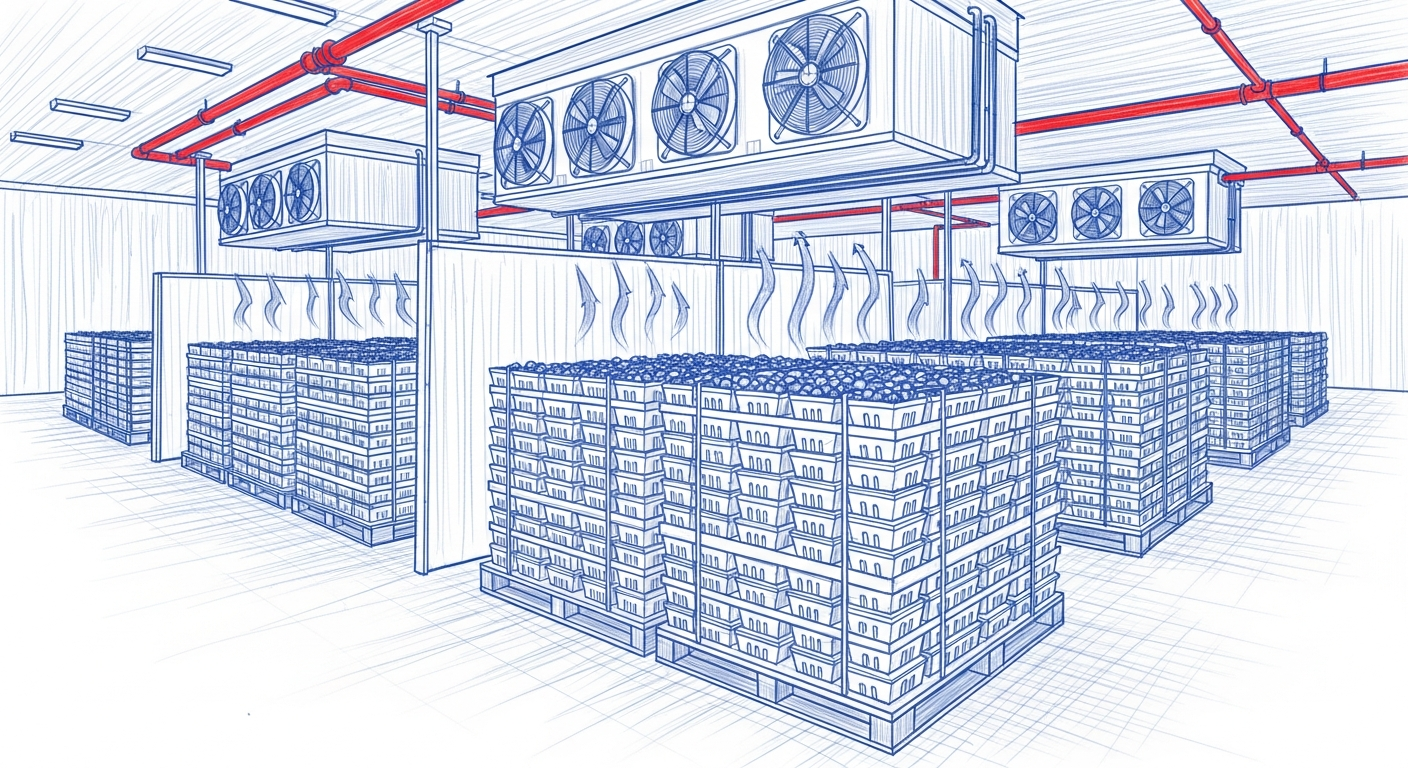
Blueberries don’t start losing quality at the packing shed. They start losing it the moment they leave the plant. Field heat is the enemy, and in a Fraser Valley August, you have very little time between the picker’s hand and the cooler before that margin starts bleeding out.
This post is for blueberry growers and operation managers in Abbotsford and the surrounding Fraser Valley who are thinking seriously about pre-cooling and cold storage before this season’s harvest. Not a product catalogue. A straight look at what the cold chain actually requires, where operations typically lose money, and what a properly built system looks like at different scales.
The Bottom Line Up Front
Every hour a blueberry sits above 4°C after harvest is shelf life you don’t get back. The farms that protect margin do it by pulling field heat fast, hitting the right temperature targets before cold storage, and maintaining the chain through to the truck. The ones that don’t pay for it in premature softening, shorter pack-out windows, and buyer pushback.
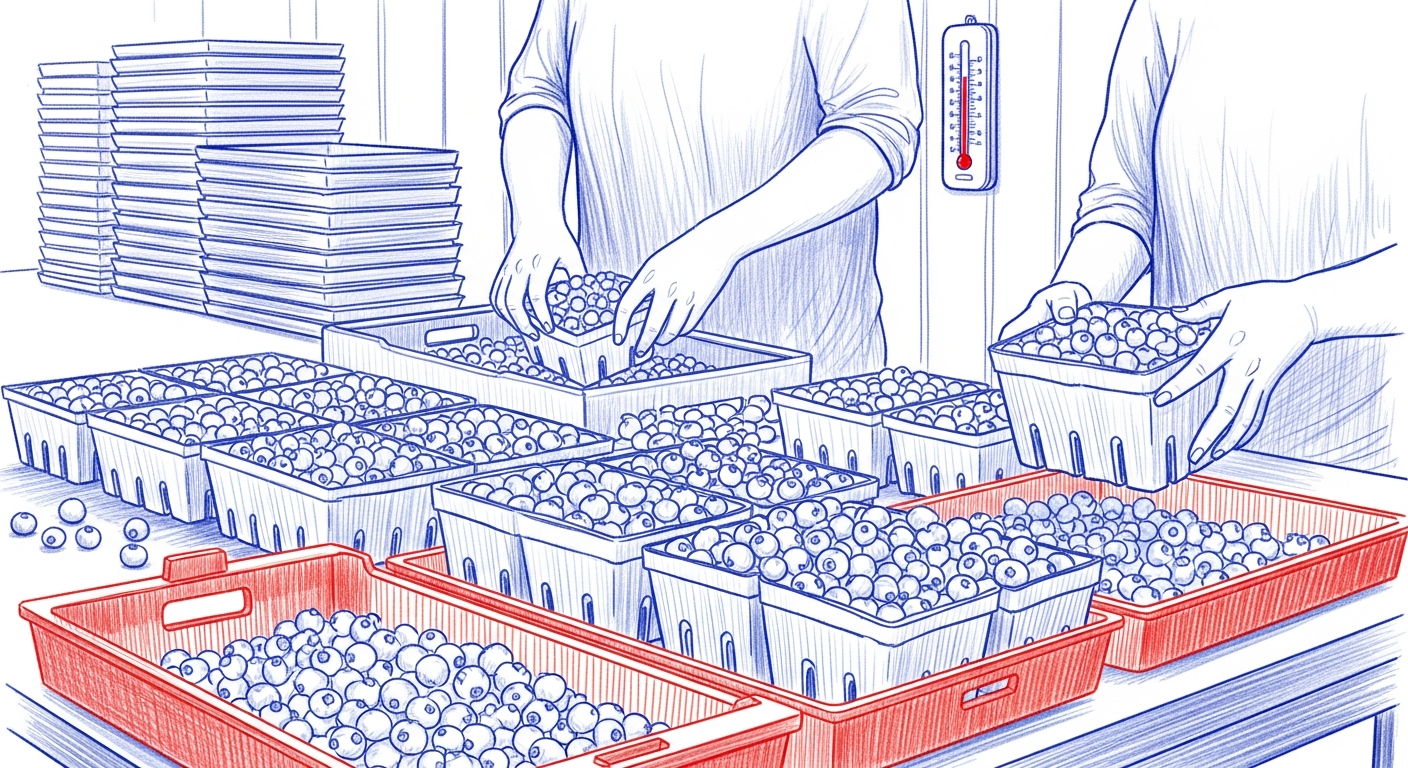
Every minute between harvest and the cooler matters. Field temperatures in August regularly reach 18°C to 25°C.
Why Pre-Cooling Is Where Margin Is Won or Lost
Cold storage is not the same thing as pre-cooling. This distinction matters more than most growers realize until it costs them.
A standard cold room is designed to maintain temperature, not to remove heat quickly. Put warm blueberries into a holding cooler and you’re asking the refrigeration system to do a job it wasn’t sized for. The room will eventually pull the product down, but “eventually” in a blueberry context can mean 12 to 24 hours of elevated temperature at the core of the fruit while the outside feels cool. That’s where the quality loss happens: inside the berry, where you can’t see it yet.
Pre-cooling is the step that removes field heat rapidly before the fruit goes into holding storage. Done correctly, it gets the pulp temperature of the fruit down to within a degree or two of your target storage temperature before the berry ever enters the cooler. That’s what protects shelf life.
A blueberry pre-cooled to 2°C within two hours of harvest will typically stay marketable for 14 to 21 days under proper storage conditions. The same berry held at ambient temperatures for four hours before cooling can lose four to seven days off that window. At commercial volumes, those days translate directly into dollars: tighter pack-out schedules, more rejected loads, lower price per flat.
The Three Pre-Cooling Methods and Which Suits Your Operation
Not every method works at every scale. Here’s what’s in use across Fraser Valley blueberry operations and what each involves.
Room Cooling
The simplest approach: a high-capacity refrigerated room with enough cooling power to pull down incoming product quickly. This works at smaller volumes when the incoming load is a manageable fraction of the room’s total capacity. What typically goes wrong is undersizing. A room spec’d for holding temperature is not automatically spec’d for pull-down load. The refrigeration system has to be sized for the incoming heat load at peak harvest volumes, not just the steady-state maintenance load.
Room cooling is adequate for smaller operations bringing in product at lower tonnages per day. Once you’re moving significant volumes per day or running multiple picks simultaneously, you need a faster method.
Forced-Air Cooling
Forced-air cooling moves refrigerated air through the product rather than just around it, dramatically increasing the rate of heat transfer. Pallets or bins are positioned against a plenum, a temporary or permanent air barrier is set up, and the refrigeration system draws air through the product rather than past it.
At Fraser Valley blueberry volumes, forced-air is the standard for mid-to-large operations. A well-designed forced-air system can pull blueberries from field temperature (often 18°C to 25°C on an August day) down to 2°C to 4°C in two to four hours, depending on the packaging and airflow design.
The variables that determine whether a forced-air system actually performs are refrigeration capacity, airflow rate, and the plenum design. An underpowered system takes too long. A system with the wrong airflow distribution leaves hot spots. We see both regularly on farms that bought equipment without proper load calculations. The fix is always more expensive after the fact than getting the design right upfront.
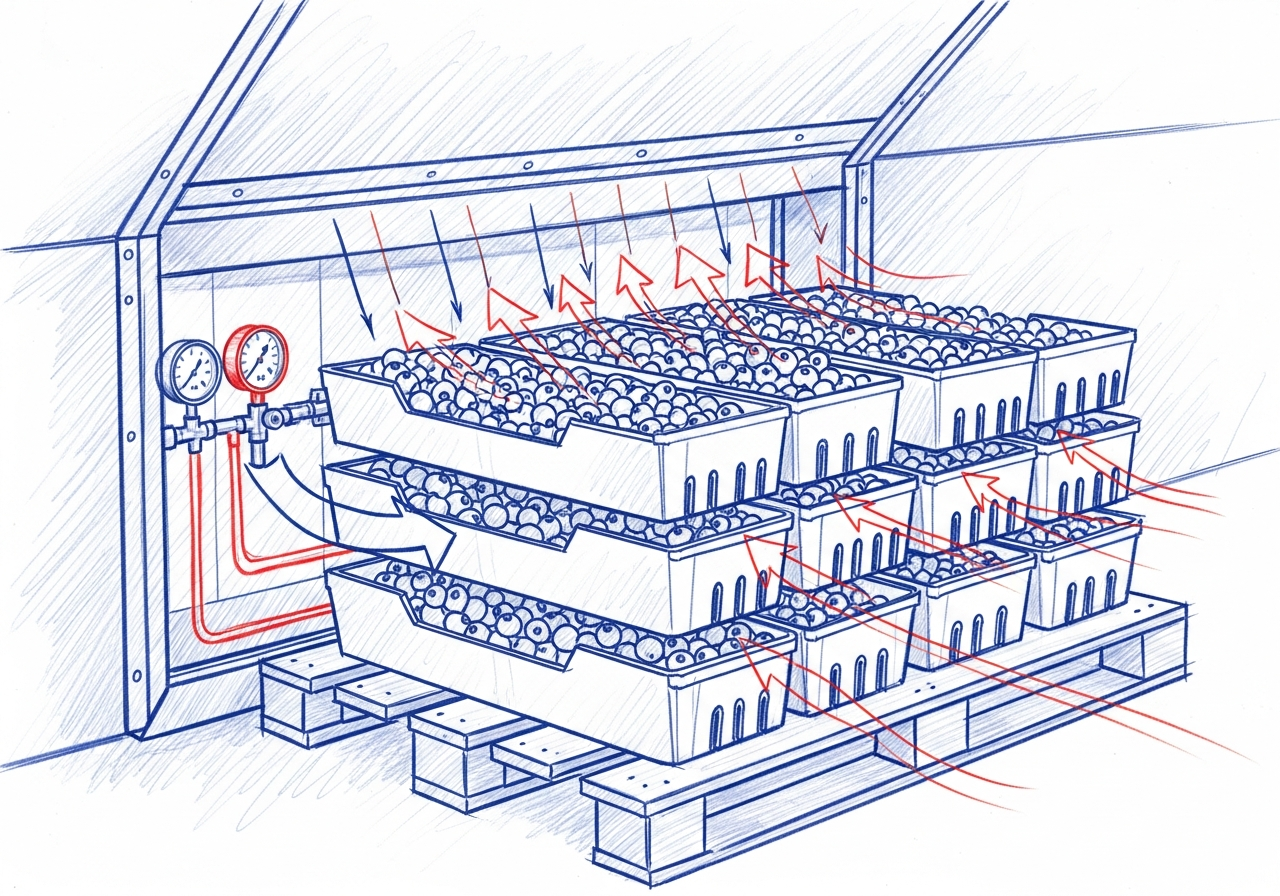
Cold air is drawn through the stacked product - not just past it - cutting pull-down time from 24 hours to two to four hours
Hydrocooling
Hydrocooling moves cold water over or through the product. It transfers heat faster than air. It also adds moisture, which affects packaging requirements and can introduce pathogen risk if the water isn’t managed properly.
For blueberries specifically, hydrocooling is less common than for other Fraser Valley crops like sweet corn or peppers. The main concern is the wax bloom on the berry skin, which the water can partially remove, reducing the visual quality premium. Some operations use it for processing-destined fruit where appearance is less critical. For fresh market blueberries, forced-air is generally the preferred method in this region.
Temperature Targets That Actually Matter
Pre-cooling targets are not arbitrary. They come from the biology of the fruit and the logistics of your market. For fresh market blueberries, the standard targets are:
- Pre-cooling target: 1°C to 4°C pulp temperature before entering holding storage
- Holding storage: 0°C to 2°C with 90% to 95% relative humidity
- Transit temperature: Maintained at 0°C to 4°C through to retail receiving
The humidity target matters as much as the temperature. Blueberries held in low-humidity storage lose moisture weight, which affects both quality and price-per-pound. A cold room that pulls temperature without managing humidity is not a well-designed blueberry storage system.
Ethylene sensitivity is relatively low for blueberries compared to other fruit, so mixed storage with ethylene-producing crops is less of a concern than it is for produce like strawberries. That said, if your operation shares cold infrastructure with other crops, confirm compatibility with the specific varieties you’re storing.
What Cold Storage Design Looks Like for Abbotsford Agricultural Refrigeration
Getting pre-cooling right is step one. The holding storage system needs to be sized and configured for what comes after it. A few things that consistently come up when we assess refrigeration setups across Abbotsford and the surrounding valley:
Refrigeration capacity is almost always undersized for peak harvest loads. Most operations size their cold room for average throughput, not peak days. In a blueberry harvest, your peak day might be three to four times your average daily volume. A system sized for average that gets hit with a peak load is working at the edge of its capacity at exactly the moment you can least afford a problem.
Airflow inside the storage room matters more than most operators think. Evaporator placement, racking configuration, and the way pallets are stacked all affect temperature uniformity. We’ve walked into operations where the product nearest the evaporator is at 1°C and product at the far end of the room is sitting at 6°C. That’s not a refrigeration problem. It’s an airflow design problem, and it’s fixable without replacing any equipment.
Defrost cycles need to be timed around harvest. If your refrigeration system goes into defrost during peak receiving hours, you’re running warm air through the room while hot product is coming in. This is a controls programming issue, not a hardware issue, but it has real consequences for product quality.
Redundancy is not a luxury at commercial volumes. A compressor failure during week two of harvest is not a maintenance inconvenience. It’s a potential total loss on whatever is in the room. Operations at commercial scale should have a plan for equipment failure: either a redundant refrigeration circuit, a service contract with guaranteed response times, or both.
Emergency Response: What “Fast Service” Actually Means at Harvest Time
Any refrigeration contractor can tell you they offer emergency service. What matters is how fast they can actually put hands on a problem during the third week of August when every farm in the valley is running at full tilt.
We service agricultural refrigeration accounts throughout the Fraser Valley. During harvest season, our commercial and agricultural calls take priority over routine residential work. If a compressor goes down at 11 PM in the middle of a blueberry harvest, that’s a different category of urgency than a home furnace issue in November, and we respond to it accordingly.
Before your season starts, it’s worth asking any contractor you work with: What is your actual response time during peak harvest season? Do you carry the parts that are most likely to fail on my specific equipment? Those are the questions that matter more than a general “24/7 available” claim.
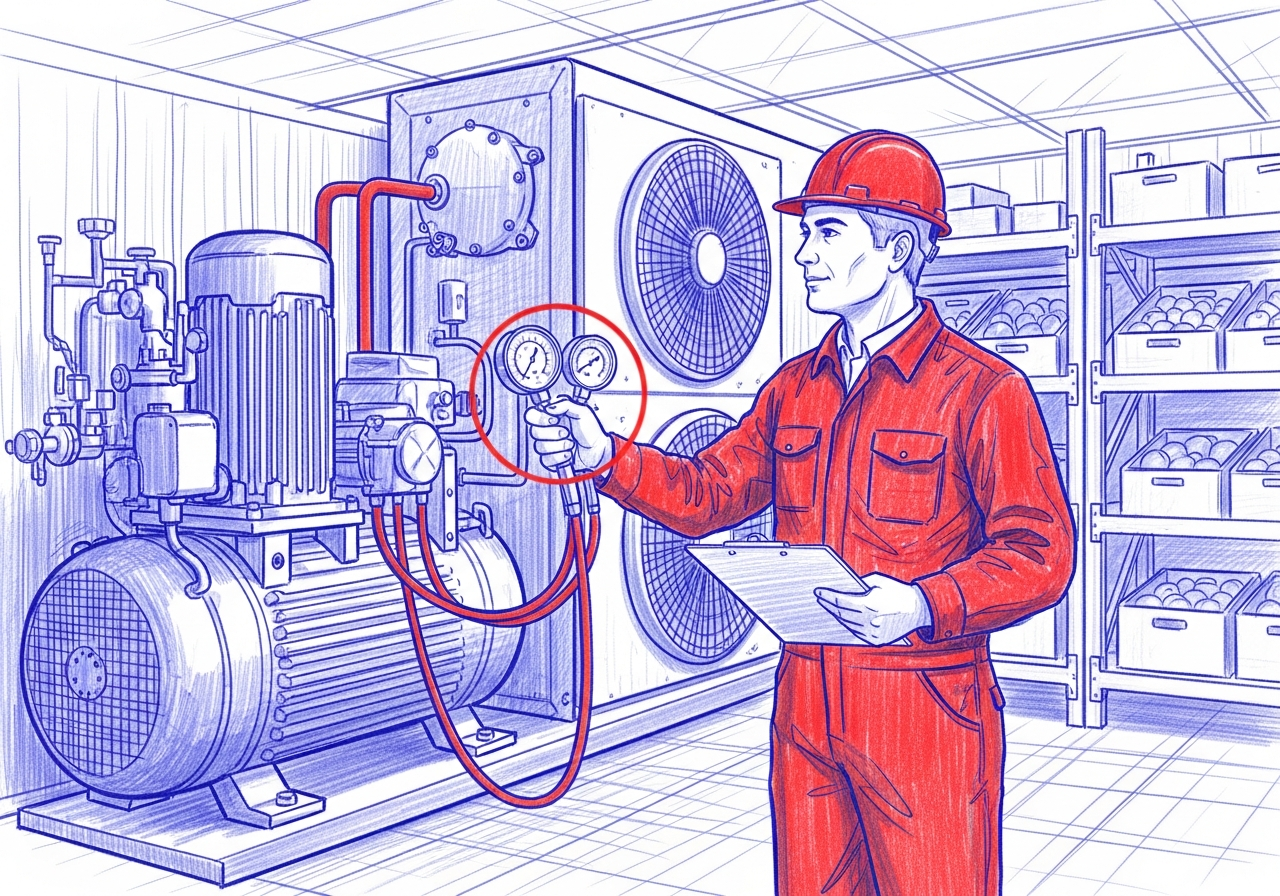
A pre-season inspection in May or June catches problems before harvest pressure makes them expensive
Getting Ready Before the Season Starts
The worst time to find a refrigeration problem is when product is on the line. A pre-season inspection in May or June, before the heat hits and before the fruit comes in, is standard practice for operations that can’t afford downtime in August. What a proper pre-season agricultural refrigeration inspection covers:
- Refrigerant charge verification and leak check
- Compressor performance check under load
- Condenser and evaporator coil cleaning
- Electrical connections and controls inspection
- Defrost system timing and function verification
- Temperature and humidity sensor calibration
- Airflow assessment within the storage space
If you’re planning an expansion or upgrade to your pre-cooling setup before this season, the timeline is tight. Equipment lead times and installation scheduling fill up fast as harvest approaches. May is the right month to start that conversation, not July.
Contact Alpine Refrigeration to schedule a pre-season inspection or to talk through what a forced-air pre-cooling system looks like for your operation.
The Bottom Line on Blueberry Cold Chain
The Fraser Valley produces more blueberries than anywhere else in Canada. The operations that protect margin do it by taking the cold chain seriously from the moment of harvest, not from the moment the product enters a cooler.
Pre-cooling is not optional at commercial scale. The method and the system design need to match your volume, your infrastructure, and your harvest pattern. Getting it wrong costs more than getting it right ever would have.
Alpine Refrigeration has been servicing agricultural and commercial refrigeration accounts across the Fraser Valley since 1969. If you want a straight assessment of your current setup or a conversation about what a pre-season upgrade looks like, reach out before harvest season closes the scheduling window.
Frequently Asked Questions About Blueberry Cold Storage in the Fraser Valley
What temperature should blueberries be stored at?
Fresh market blueberries should be held at 0°C to 2°C with 90% to 95% relative humidity. Pre-cooling should bring pulp temperature to 1°C to 4°C before the fruit enters holding storage. Berries held above 4°C for extended periods lose shelf life at a rate that compounds quickly in warm ambient conditions.
What’s the difference between pre-cooling and cold storage?
Pre-cooling is the active process of rapidly removing field heat from freshly harvested fruit, typically using forced-air or room cooling methods. Cold storage is the holding environment that maintains the product at target temperature after pre-cooling. Skipping or shortcutting pre-cooling and relying on cold storage to do both jobs results in slow pull-down times and quality loss at the core of the fruit.
How much does a forced-air pre-cooling system cost?
It depends heavily on your throughput volume, the existing infrastructure, and whether you’re building new or retrofitting. We don’t quote from a rate card on agricultural installations. Every system gets assessed on-site. If you’re planning for this season, contact us now rather than in July when scheduling is tight.
Can I use my existing cold room for pre-cooling?
Maybe. It depends on whether the refrigeration system is sized for pull-down load rather than just maintenance load, and whether the airflow configuration supports rapid heat transfer. We can assess your existing equipment and tell you honestly whether it can handle pre-cooling duty or whether you need a dedicated system.
What crops can be stored alongside blueberries?
Blueberries have relatively low ethylene sensitivity, so mixed storage is less problematic than it is for some other produce. That said, any mixed storage situation should be reviewed on a crop-by-crop basis. Some produce emits ethylene at high rates or requires different humidity targets, which can affect blueberry quality over a multi-week storage window.
What should I look for in an agricultural refrigeration contractor in the Fraser Valley?
Experience with produce cold chain specifically, not just HVAC. The ability to respond during harvest season, not just during off-peak months. Willingness to do a proper load calculation and airflow assessment, not just quote based on room square footage. And a clear answer to: what happens if something fails at 11 PM during peak harvest?