Avian Flu Biosecurity Ventilation: What Fraser Valley Poultry Operators Need to Know
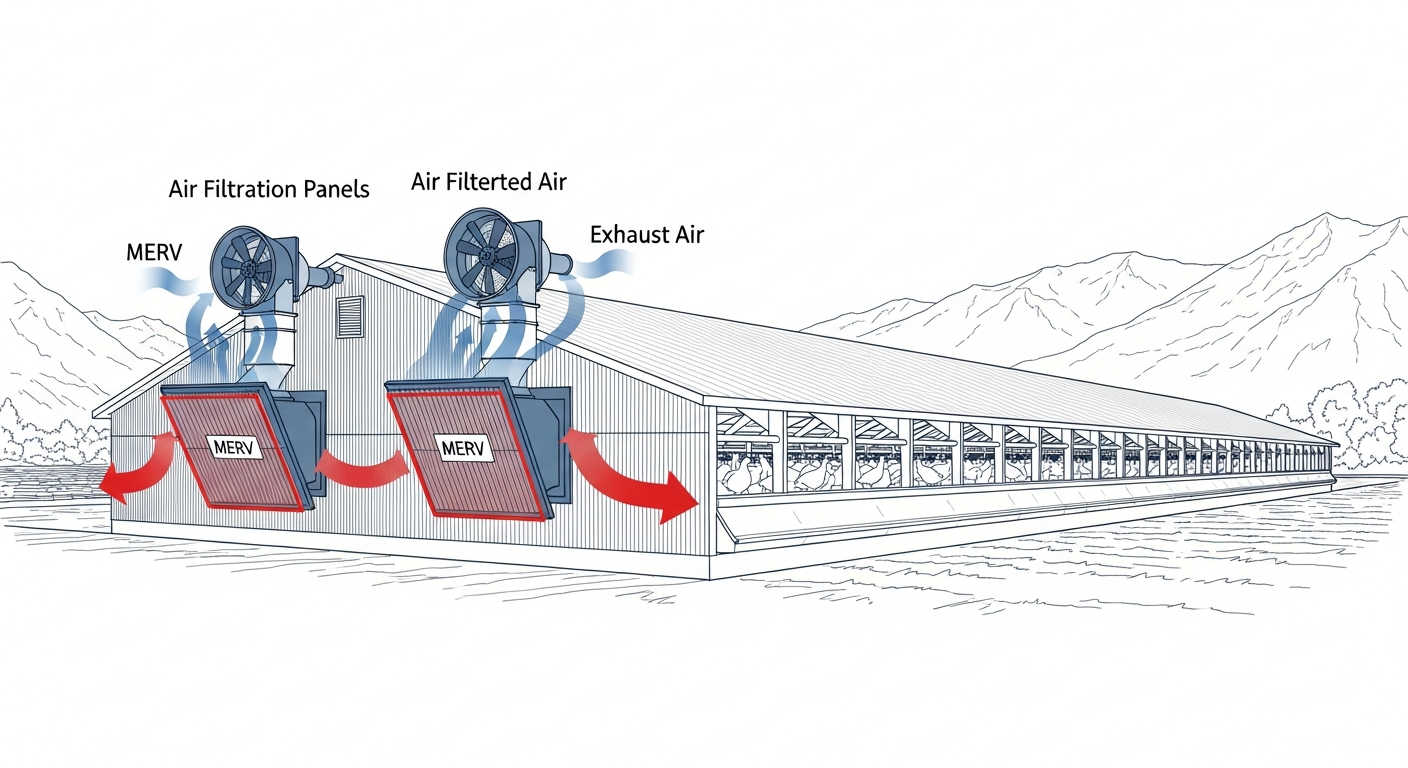
British Columbia confirmed highly pathogenic avian influenza (HPAI) in 31 commercial poultry flocks in 2025, more than any other province in Canada for the fourth consecutive year. The majority of those cases were in Abbotsford and Chilliwack.
Farmers in this region have been living with that reality since 2022. Enhanced biosecurity protocols are standard. Birds stay indoors during wild bird migration seasons. And yet the outbreaks keep coming.
The reason is airborne transmission. The H5N1 strain moves through air, not just through physical contact with wild birds or contaminated equipment. That’s what makes ventilation the next layer of protection worth understanding, and it’s why the Province of BC launched a $2.5-million Novel Tools and Technologies Program specifically targeting barn air filtration and airflow management for Fraser Valley farms.
This post covers what the ventilation side of HPAI biosecurity actually involves, what technologies are being tested in the Fraser Valley right now, and how to think about upgrading a barn that was designed for climate control but not pathogen filtration.
Key Figure
Since the first major outbreak in 2022, roughly 200 commercial and small-flock farms in the Fraser Valley and Lower Mainland have been affected, with an estimated 9 million birds depopulated across BC. The economics of a single outbreak on a commercial operation are severe - biosecurity ventilation is increasingly being evaluated against that number.
Why Ventilation Is Now Part of the Biosecurity Conversation
Poultry barn ventilation has always been about bird welfare: controlling temperature, humidity, ammonia levels, and airflow to keep birds healthy and productive. Biosecurity ventilation adds a different requirement: keeping the outside air that comes into the barn from carrying HPAI into the flock.
Those two goals don’t automatically conflict, but they don’t automatically align either. A well-designed conventional ventilation system moves large volumes of air efficiently. HPAI biosecurity ventilation adds filtration, pressure management, or both to that airflow, which affects system performance and requires careful engineering to avoid compromising the climate control function the birds depend on.
Most Fraser Valley farms that have experienced outbreaks had solid protocol-based biosecurity in place. The airborne vector is what’s driving the push toward engineering-level controls - and toward the four technologies now being deployed and studied in the region.
The Four Technologies Being Deployed in the Fraser Valley
The BC Novel Tools and Technologies Program, which provides up to $30,000 per farm for eligible projects, covers four main technology categories. Each addresses a different part of the airborne transmission problem.
MERV 16 Filtration with Heat Exchangers
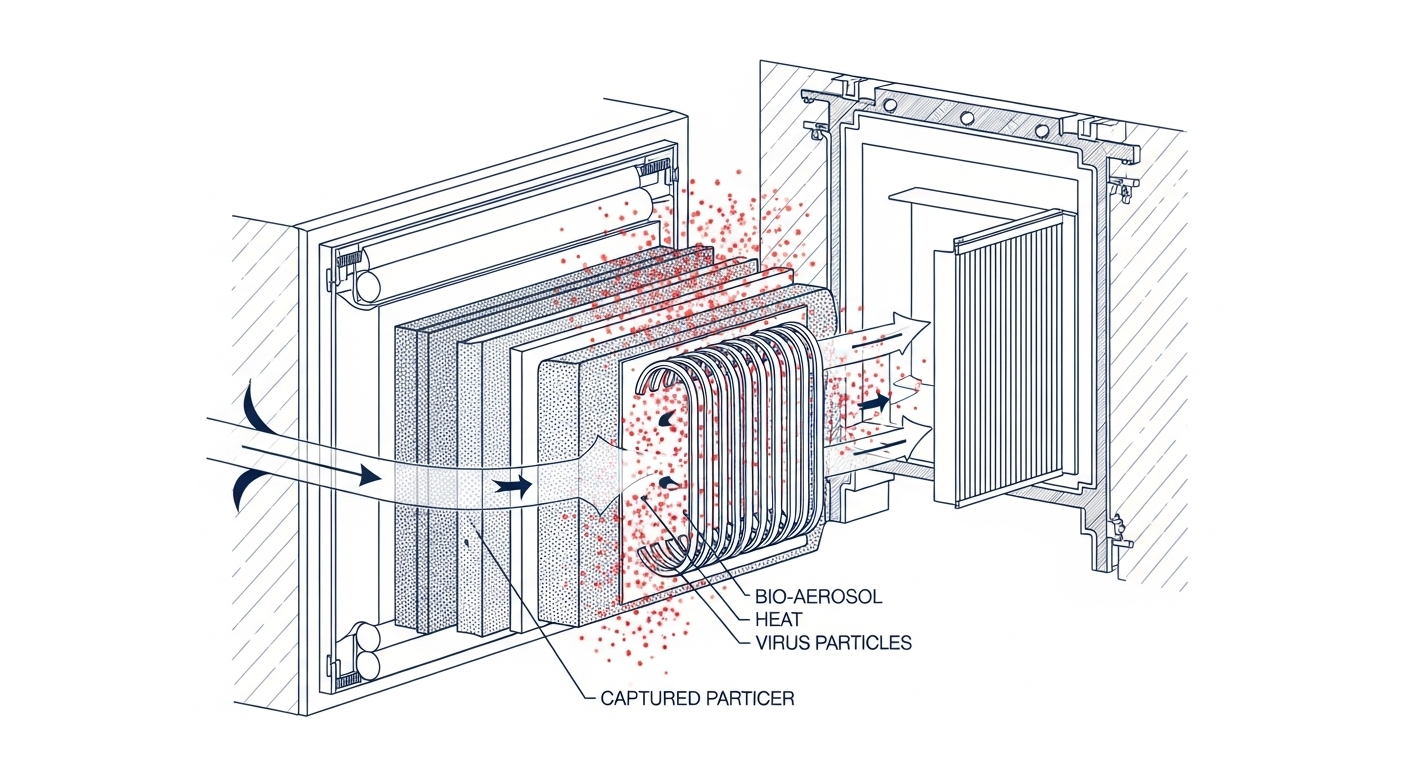
This is the closest equivalent to hospital-grade air filtration. MERV 16 filters capture particles down to 0.3 microns, including the bio-aerosols that carry HPAI. A Chilliwack-area chicken farmer documented in CBC News (November 2025) has installed heat exchangers with MERV 16 filtration as part of the working group pilot.
The practical challenge is airflow resistance. MERV 16 filters create significantly more static pressure than the MERV 6 or 8 filters most agricultural ventilation systems were designed around. Retrofitting a barn with high-efficiency filtration requires confirming that fan capacity can overcome the additional resistance without reducing the air exchange rate the birds need.
In new construction or major renovations, the system can be designed for the filter specification from the start. In retrofit situations, a fan performance assessment is the first step.
Ultraviolet Light (UV-C) Disinfection Systems
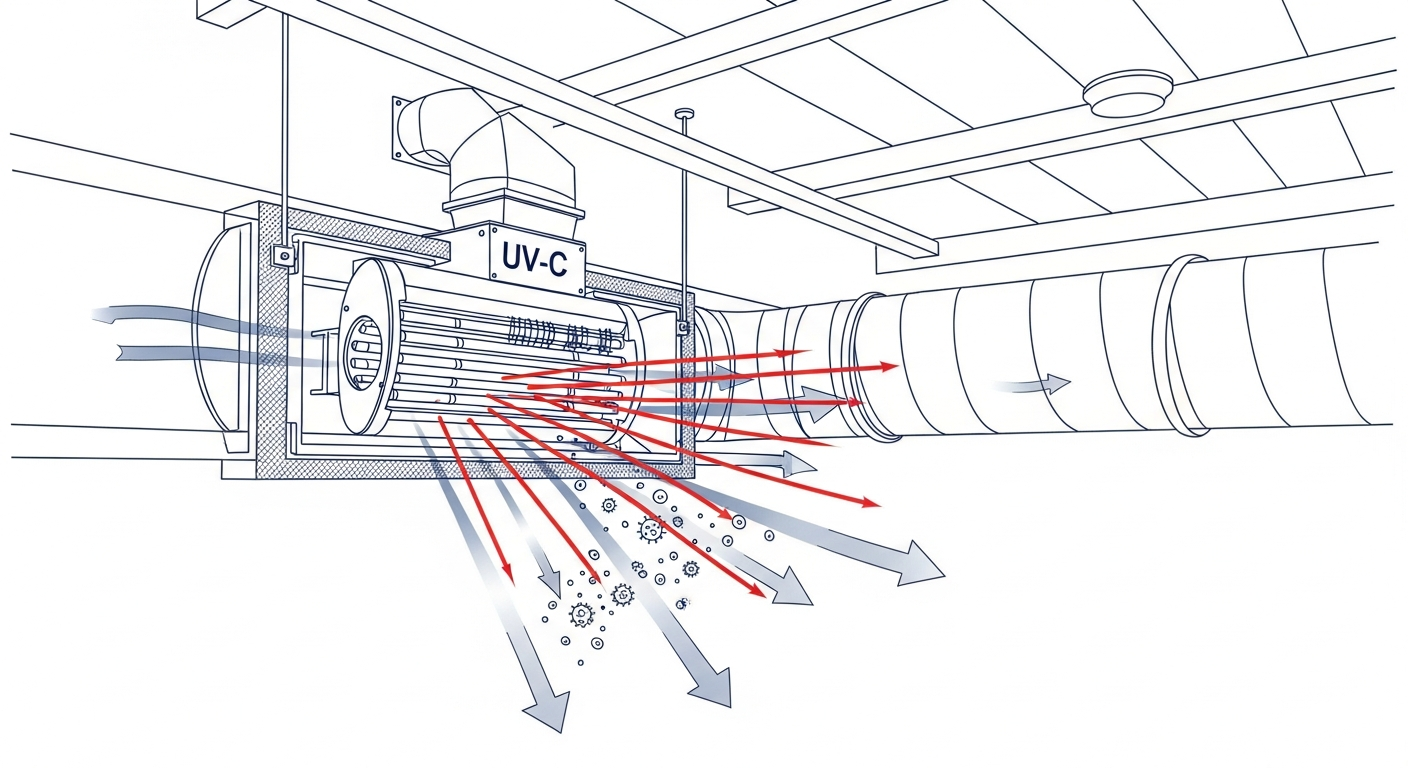
UV-C light at the right wavelength and exposure time inactivates airborne pathogens, including influenza viruses. UV-C systems are installed in the air handling pathway, either in ducts or at air intake points.
The advantage over filtration is that UV-C doesn’t restrict airflow. The limitation is that efficacy depends on airflow speed through the UV zone, lamp intensity, and regular maintenance. A lamp running at 60 percent output due to dust buildup is not delivering 60 percent of the biosecurity benefit - it’s delivering considerably less.
UV-C is most effective as a layered addition to filtration, not a standalone replacement.
Electrostatic Precipitator Systems
Electrostatic precipitators charge airborne particles, then collect them on oppositely charged plates. They’re effective at removing dust, dander, and bio-aerosols from recirculated air inside the barn.
This technology is better suited to reducing pathogen load in recirculated internal air than to treating incoming outside air. For barns where internal air quality management is the priority, it’s a useful tool. For incoming air treatment, filtration or UV-C is more appropriate.
Positive Pressure Ventilation
Conventional barn ventilation is often negative pressure: fans exhaust air out, and makeup air enters through controlled inlets. Positive pressure ventilation reverses that logic by pressurizing the barn interior slightly above ambient. This creates an outward air bias that resists infiltration of unfiltered outside air through gaps, seams, and non-intake openings.
Positive pressure systems are more demanding to engineer correctly than negative pressure systems. The barn envelope needs to be reasonably tight to maintain pressure differential, and inlet filtration is still required. On older barns with significant envelope leakage, positive pressure alone won’t solve the problem without air sealing work.
What Actually Gets Into a Barn and How
Understanding the transmission pathways helps prioritize which technology fits a given farm’s situation.
- Intake air - The primary target for filtration and UV-C. If the incoming air volume is large and continuous, filtration at the intake needs to handle both the volume and the pressure drop without starving the barn.
- Infiltration through the envelope - Gaps around doors, panels, cable penetrations, and worn seals let untreated air in. No intake filtration system addresses this. Air sealing combined with positive pressure management is the relevant response.
- Personnel and equipment movement - Ventilation technology doesn’t cover this vector at all. Shower-in shower-out protocols, dedicated barn clothing, and equipment disinfection remain critical regardless of what the air handling system does.
Most Fraser Valley farms that have experienced outbreaks had solid protocol-based biosecurity in place. The airborne vector is what’s now driving the push toward engineering-level controls.
How This Affects Existing Barn HVAC Systems
The majority of commercial poultry barns in the Fraser Valley were designed and built without HPAI filtration in mind. The ventilation systems are typically fan-and-inlet negative pressure setups, sized for the thermal and air quality load, not for filter resistance. Retrofitting biosecurity ventilation onto an existing system requires working through a few questions:
- Fan capacity margin. If the existing fan array is running near capacity at peak summer ventilation demand, adding filtration resistance will reduce airflow and either compromise bird welfare or require fan additions or replacements.
- Inlet sizing and configuration. Filtration media needs surface area to function at manageable face velocity. Undersized inlets with filtration become choke points. Inlet retrofits are often part of the upgrade.
- Structural integration. MERV 16 filter housings and UV-C systems need to be mounted, sealed, and accessible for maintenance - physical space and structural load that a system installed in the 1990s or 2000s wasn’t designed around.
- Controls integration. Pressure sensors, filter condition monitoring, and UV lamp performance tracking should tie into the barn controls if possible. A filter that’s loaded and bypassing air defeats the purpose.
None of this is insurmountable, but it’s also not a simple add-on. A barn assessment before any equipment is ordered is the right starting point.
The Funding Picture for 2026
Application Deadline: June 30, 2026
The BC Novel Tools and Technologies Program has an active intake running June 1 to 30, 2026. If you’re planning upgrades for the fall migration season, the scope needs to be defined now.
The BC Novel Tools and Technologies Program has an active intake running June 1 to 30, 2026. This round has more than $1.4 million available, administered by the Investment Agriculture Foundation of BC (IAFBC), with approximately 50 eligible commercial farms in the high-risk zone able to access support.
The program covers air filtration systems, UV-C disinfection systems, electrostatic precipitators, and positive pressure ventilation. Eligible farms are in the Fraser Valley, Langley, and Surrey. To qualify, operations need to hold chicken or turkey quota under Canada’s supply management system, or raise more than 300 ducks or geese commercially. Projects must have begun after January 1, 2025.
The per-farm funding won’t cover a full barn retrofit in most cases, but it meaningfully offsets the cost of a filtration upgrade or UV-C installation.
For current program details and to apply, visit the Investment Agriculture Foundation of BC at iafbc.ca/novel-tools-and-technology or contact the BC Ministry of Agriculture and Food directly.
What We See Working in the Field
The farms in the working group pilot that have installed MERV 16 filtration with heat exchangers are early in the data collection phase. What’s already clear from the field is that barn-specific factors matter more than a one-size-fits-all technology recommendation.
An older barn with a loose envelope and fans running near capacity in summer isn’t a good candidate for high-resistance filtration without fan work first. A newer, tighter barn with capacity margin is a different story. The conversation starts with the barn, not the product.
From our poultry refrigeration and barn equipment work across Chilliwack, Abbotsford, and Mission, the farms best positioned to add biosecurity ventilation are consistently the ones with well-maintained underlying systems. When we arrive at a barn where fans are balanced and controls are calibrated accurately, adding a filtration layer is a straightforward engineering conversation.
When to Call a Contractor
Ventilation biosecurity isn’t a DIY project or a filter swap. It involves airflow engineering, equipment compatibility, and installation that needs to function reliably in a farming environment where failure has real consequences.
The right time to get a contractor involved is before you apply for program funding, not after. The scope you submit for funding should be grounded in an actual barn assessment, not a product brochure. A site visit establishes fan capacity, inlet configuration, envelope condition, and the realistic upgrade path for your specific building.
Alpine Refrigeration serves poultry operations across Chilliwack, Abbotsford, and Mission. If you’re considering biosecurity ventilation upgrades for the 2026 season, contact us for a site assessment before committing to a specific technology or equipment spec. You can also read our related post on smart ventilation strategies for poultry and livestock barns for more on the fundamentals.
Frequently Asked Questions
What is HPAI and why is it a problem for Fraser Valley poultry farmers?
Highly pathogenic avian influenza (HPAI) is a severe strain of bird flu that causes rapid illness and death in infected flocks. BC confirmed 31 commercial flock infections in 2025, more than any other province, with most cases in Abbotsford and Chilliwack. The H5N1 strain spreads partly through airborne transmission, which makes ventilation management relevant even on farms with strong protocol-based biosecurity.
Can ventilation upgrades actually stop HPAI from entering a barn?
No ventilation system offers a guarantee against HPAI transmission. What MERV 16 filtration, UV-C disinfection, and positive pressure ventilation do is reduce the airborne transmission risk from incoming and recirculated air. They’re one layer in a multi-layer biosecurity approach, alongside personnel protocols, equipment disinfection, and water management.
What is the BC Novel Tools and Technologies Program?
It’s a provincial program administered by the Investment Agriculture Foundation of BC that funds HPAI-reducing technologies for eligible poultry farms in the Fraser Valley, Langley, and Surrey. The current intake is open June 1 to 30, 2026, with more than $1.4 million available in this round. Covered technologies include air filtration, UV-C systems, electrostatic precipitators, and positive pressure ventilation. Visit iafbc.ca/novel-tools-and-technology for eligibility criteria and application details.
Will adding MERV 16 filtration hurt my existing ventilation system?
It can, if the existing fans don’t have enough capacity to overcome the added static pressure. That’s why a fan capacity assessment is the first step in any filtration retrofit. Undersizing airflow to the birds to accommodate filters creates a different welfare and production problem.
How often do biosecurity ventilation components need maintenance?
UV-C lamps lose output gradually and should be checked and replaced on the manufacturer’s schedule, typically annually or per-hours-of-operation. Filters need regular monitoring for loading and replacement. Electrostatic precipitator collection plates need periodic cleaning. All of these maintenance tasks should be scheduled into your seasonal barn management calendar.
Does Alpine Refrigeration work with poultry farms on biosecurity ventilation?
Yes. We work with poultry and mixed agricultural operations in Chilliwack, Abbotsford, and Mission on ventilation assessments and upgrades. A site visit is the right starting point for any biosecurity ventilation project. Contact us to schedule a barn assessment.